Fájl:Homemade superheterodyne receiver 1920.jpg
Ugrás a navigációhoz
Ugrás a kereséshez
Az előnézet mérete: 527 × 599 képpont További felbontások: 211 × 240 képpont | 422 × 480 képpont | 675 × 768 képpont | 900 × 1 024 képpont | 2 212 × 2 516 képpont.


Eredeti fájl (2 212 × 2 516 képpont, fájlméret: 676 KB, MIME-típus: image/jpeg)

Összefoglaló
| Leírás |
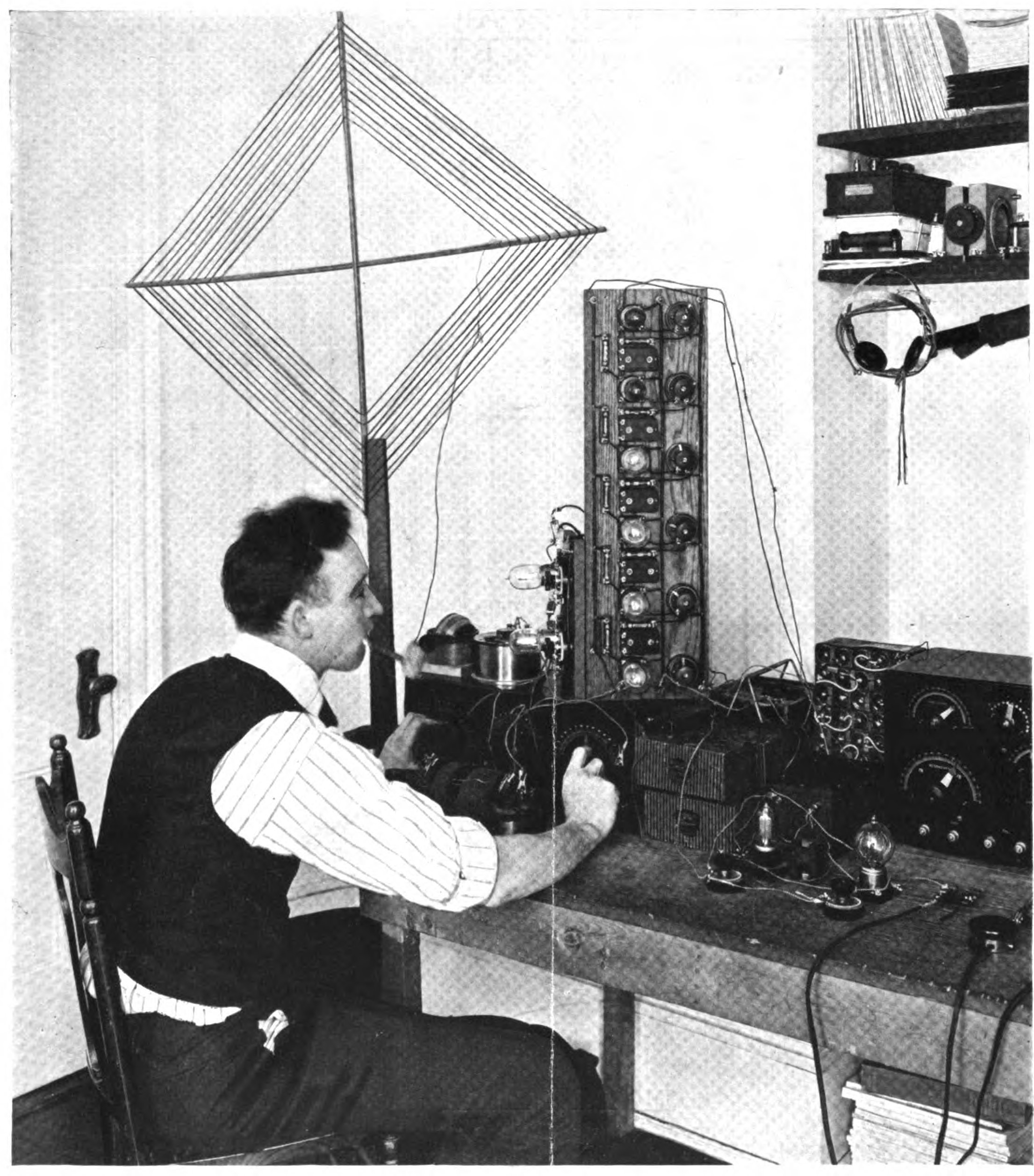
English: The first amateur superheterodyne receiver, an illustration for a do-it-yourself article in a 1920 amateur radio magazine. The superheterodyne circuit on which virtually all modern receivers are based was invented in 1918 during World War 1 by Edwin Armstrong when he was a captain in the U.S. Signal Corps, part of a secret project to eavesdrop on German radio communications. Paul F. Godley (in photo), a radio amateur and receiver expert for American Marconi during the war, heard about it and built this homebrew version (Armstrong's paper on the superheterodyne hadn't even been published yet) Described in companion article Paul F. Godley, "High Amplification at Short Wave Lengths," The Wireless Age, February 1920, p. 11-14, it is a 9-tube superheterodyne using Western Electric VT triodes. One tube is the mixer, which has regeneration to improve the selectivity; one is the local oscillator; there are 5 RC-coupled stages of IF amplification (mounted on the vertical board), the last of which serves as a detector; and 2 transformer-coupled audio amplifier stages. It uses an intermediate frequency (IF) of around 50 kHz. The attraction of the new superheterodyne circuit, as indicated by the article title, was that it could reach higher frequencies than existing receivers, up to the 200 meter (1.5 MHz) shortwave band, and was also more sensitive. The circuit was so new that the word "superheterodyne" doesn't even appear in the article. In December, 1921, Godley took this receiver to Ardrossan, Scotland, for a historic, amateur, transatlantic shortwave demonstration. Radio amateurs showed that, due to skywave ("skip") transmission, their small homemade shortwave transmitters could do what the huge, expensive, 100-500 kilowatt longwave stations could do - communicate telegraphically between America and Europe. Godley's superheterodyne surpassed conventional receivers, receiving transmissions from 27 amateur stations in North America, even though the amateur transmitters all had output power of between 50 watts and 1 kilowatt. |
| Dátum | |
| Forrás | Downloaded 23 September 2013 from Paul F. Godley, "High Amplification at Short Wave Lengths" in The Wireless Age, Wireless Press, Inc., New York, Vol. 7, No. 5, February 1920, front page on Google Books |
| Szerző | Paul F. Godley |
Licenc
 |
Ez a fájl közkincsnek minősül az Amerikai Egyesült Államokban. Ez az olyan USA-ban készült művekre vonatkozik, amelyeknek lejárt a védelmi idejük, általában azért, mert 1930. január 1. előtt publikálták. Lásd ezt a lapot a további magyarázathoz.
|
 |
 |
| Képjegyzetek | Ehhez a képhez képjegyzetek tartoznak: Képjegyzetek megtekintése a Commonson |
Fájltörténet
Kattints egy időpontra, hogy a fájl akkori állapotát láthasd.
| Dátum/idő | Bélyegkép | Felbontás | Feltöltő | Megjegyzés | |
|---|---|---|---|---|---|
| aktuális | 2013. szeptember 27., 05:34 | | 2 212 × 2 516 (676 KB) | wikimediacommons>Chetvorno | User created page with UploadWizard |
Fájlhasználat
Az alábbi lap használja ezt a fájlt:
